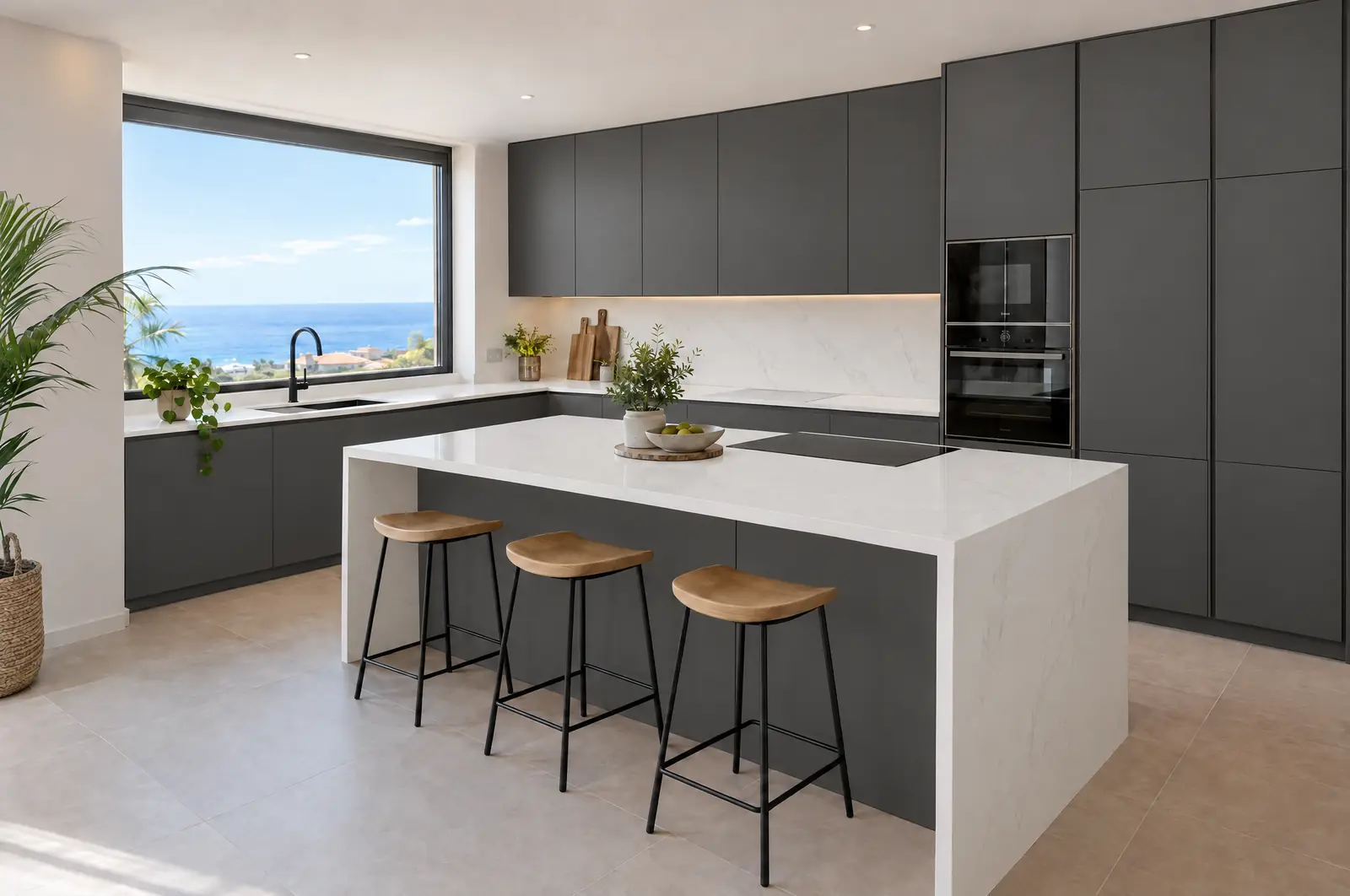
Choosing a cooker hood depends on three things: whether you have an extraction outlet to the outside, where the hob goes and how much you cook. Design comes afterwards, because a good-looking hood that does not extract leaves a smell of frying in the living room and condensation on the wall units.
Ducted or recirculating hood
The basic difference is that a ducted hood expels air outside the home, while a recirculating hood filters it and returns it to the kitchen. The first removes grease, odour, steam and heat; the second only traps some of the grease and odours.
Whenever a duct is available, extracting to the outside is the best option. For it to work well, the duct should be as short and straight as possible, with the fewest bends, and of the diameter the manufacturer specifies, normally between 120 and 150 mm. Reducing the diameter or chaining several bends greatly lowers the real extraction and raises the noise.
Types of hood by position
Each type of hood suits a hob position and a kitchen style. These are the most common:
- Wall-mounted chimney hood: the classic chimney or angled-glass hood above the hob. It is effective, easy to install and very visible, so it becomes part of the design.
- Integrated in a wall unit: also called a canopy or telescopic hood. It is concealed inside a unit and only the underside or a pull-out front is visible. It is the most discreet option in kitchens with a continuous row of wall units.
- Ceiling hood: a panel recessed into a false ceiling, normally with a remote control. It keeps the view clear above the island or hob, but extracts less well because it is far from the source of the fumes and needs more airflow.
- Island hood: suspended from the ceiling above a hob on the island. With no wall behind it, the fumes spread more, which is why it should be somewhat wider than the hob.
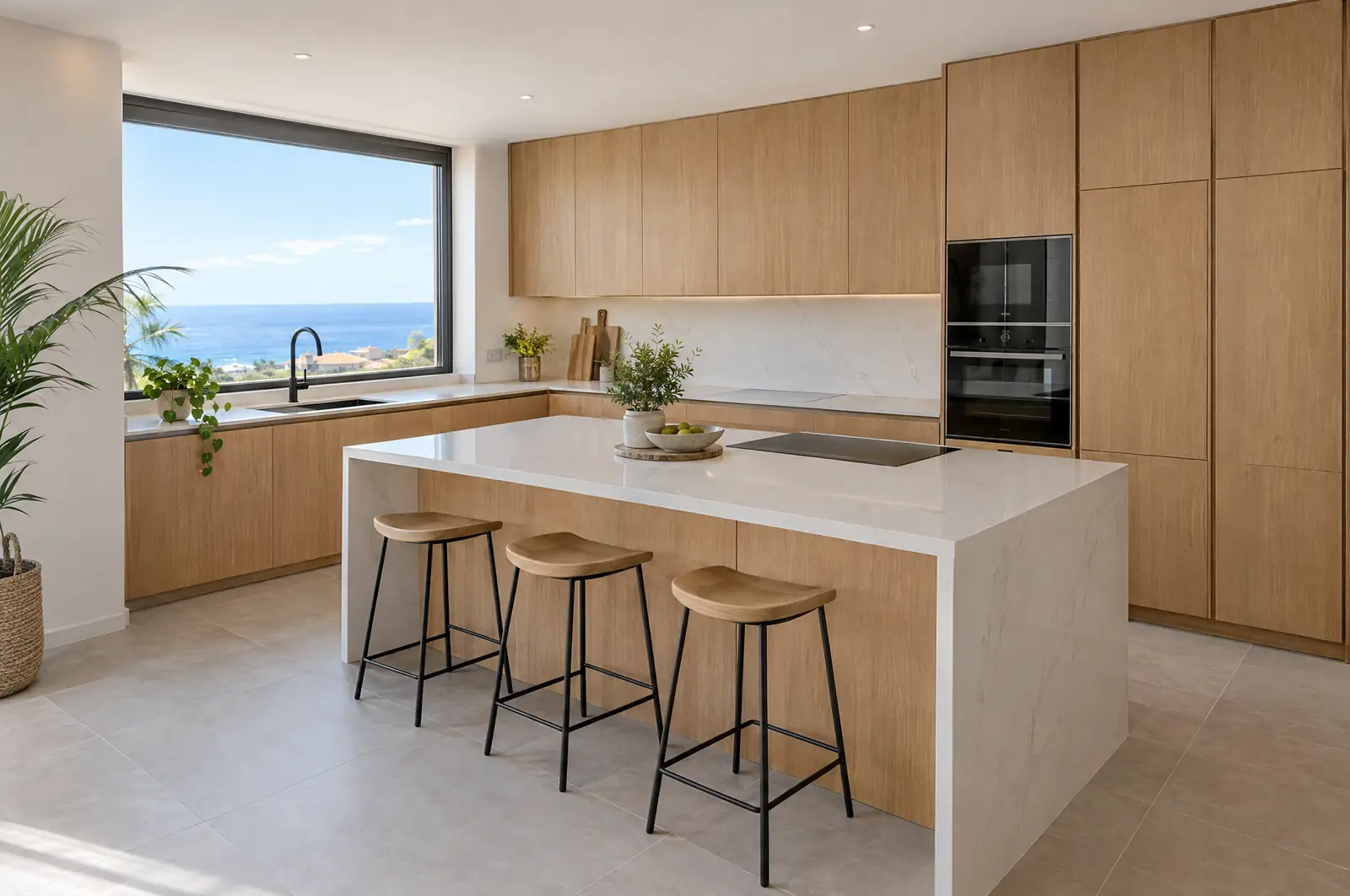
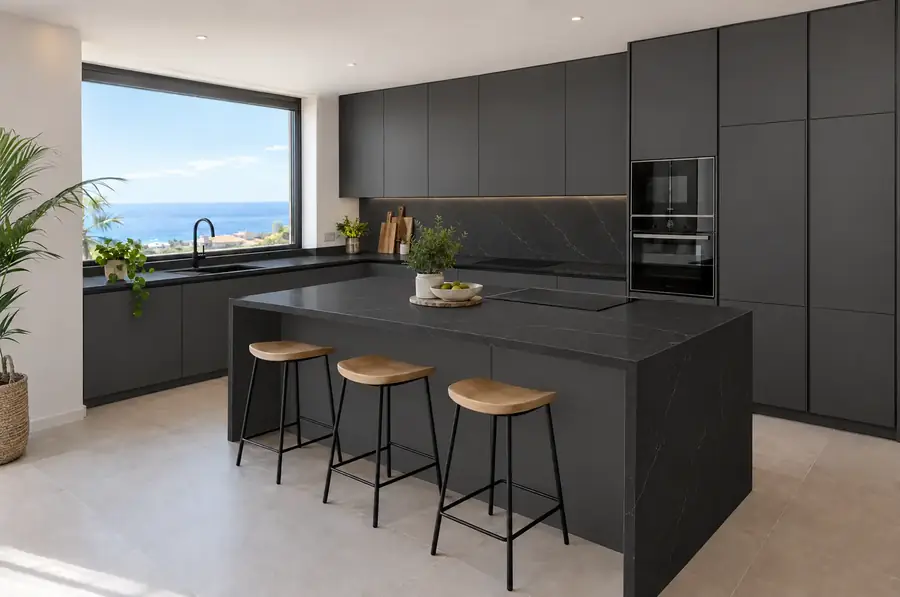
If you are going to put the hob on the island, think from the outset about where the duct would run. The page about island kitchens covers how this is solved.
How much power you need
A cooker hood’s power is measured in cubic metres per hour, and the most widely used rule of thumb is that it should change the air in the kitchen about 10 to 12 times an hour. To work it out, multiply the kitchen’s length by its width by its height and then by 10 or 12. A kitchen of 3 by 2.5 metres with a height of 2.5 has about 19 m³, so it needs around 190 to 225 m³/h at the everyday speed; the maximum figure in the catalogue may be considerably higher.
If the kitchen is open to the living room, count the volume of the whole space or at least be more generous. Look at the airflow at the speed you will use every day, not only at the boost speed, which usually lasts a few minutes. And choose a hood at least as wide as the hob; for an island or ceiling hood, ideally a little wider.
Hood with no extraction outlet: when it works
A hood with no extraction outlet works by recirculation: the air passes through a metal filter that traps grease and then through an activated carbon filter that absorbs some of the odours, and goes back into the kitchen. It is the solution when there is no way to run a duct outside.
It works reasonably well in these cases:
- Kitchens with an induction hob, which does not produce combustion gases.
- Light, everyday cooking, without much frying or intensive griddling.
- Kitchens with good natural ventilation, such as a window you can open while cooking.
Its limits are clear. It does not remove water vapour or heat, so in a closed kitchen with no window the moisture condenses on ceilings and units, something more noticeable in coastal homes, where the air is already humid. It retains odours only partly, and less as the carbon becomes saturated. Carbon filters have to be replaced or regenerated as often as the manufacturer states, often every few months of use; if not, the hood just moves the air around.
The case of flats
In many flats the problem is not the hood but the lack of an available extraction duct. Some buildings have a shared ventilation duct, others have an individual outlet through a light well or the roof, and others simply have nothing.
Running a duct out through the façade is not a decision you can take alone: the façade is a common element and usually requires the agreement of the owners’ association (comunidad de propietarios) and council authorisation. Connecting to an existing shared duct also has its rules, because sharing it badly can carry odours into other homes. If you are thinking of opening a new outlet, read the guide on the kitchen renovation permit before talking to the owners’ association.
If there is a gas water heater or an open-flue boiler in or near the kitchen, consult an installer before fitting a powerful ducted hood: in enclosed spaces it can disrupt the appliance’s flue draught.
Installation height and noise
The correct height above the hob is set by the manufacturer of each hood. Over gas hobs, manuals usually require at least 65 cm, and if the hob’s manual asks for more, that figure applies; over induction or ceramic hobs many models allow less. Lower than specified, it gets in the way and with gas it can be dangerous; much higher, it extracts less well.
Noise is the main reason many people do not switch the hood on. Compare the decibels at normal-use speed, and consider quieter motors if the kitchen is open to the living room. The guide on how to design a kitchen shows how the hood fits in with the other heights.
How to decide for your kitchen
If you have an extraction outlet, choose the type of hood by the position of the hob and the style, and size the airflow by the volume. If you do not, first assess whether it is feasible to create one; when it is not, a good recirculating hood combined with induction and a window that opens is a decent solution. In a kitchen design project this decision is taken at the start, because it affects the layout and the wall units.