If you are going to replace your kitchen in Tenerife, whether you need a permit depends on what the work touches, not on its budget. In the Canary Islands this is decided by the Ley 4/2017, de 13 de julio, del Suelo y de los Espacios Naturales Protegidos de Canarias (Canary Islands Land and Protected Natural Areas Act 4/2017 of 13 July), which separates work that needs a licence (article 330), work that only needs to be notified to the council (article 332) and work that needs no procedure at all (article 333). Each council (ayuntamiento) on the island then sets the form, the documentation and the fees, and it is the council that confirms which procedure applies to your work.
Replacing units and finishes without touching the services
Replacing the kitchen units, the worktop or the appliances, and renewing the floor, tiling or paintwork, needs neither a licence nor prior notification (comunicación previa). The law exempts from any enabling permit the replacement of interior finishes in a home, such as floors, tiling, plasterwork and paint, provided the home is not architecturally protected (article 333.1.c). Fitting new units in the same place, with the same water supply, waste and electrical points, is not even building work in the planning sense.
This also covers replacing the kitchen doors or swapping the cooker hood for another one that uses the same duct. There are two nuances. The law itself points out that you need whatever authorisations apply to remove the rubble, and if you are going to occupy the public highway with a skip, that requires its own council permit (article 333.2). Scaffolding or cranes resting on the road, or that leave less than 1.20 metres of clear passage on the pavement, also need a licence (article 330.1.p).
Renovation involving services or partition walls: prior notification
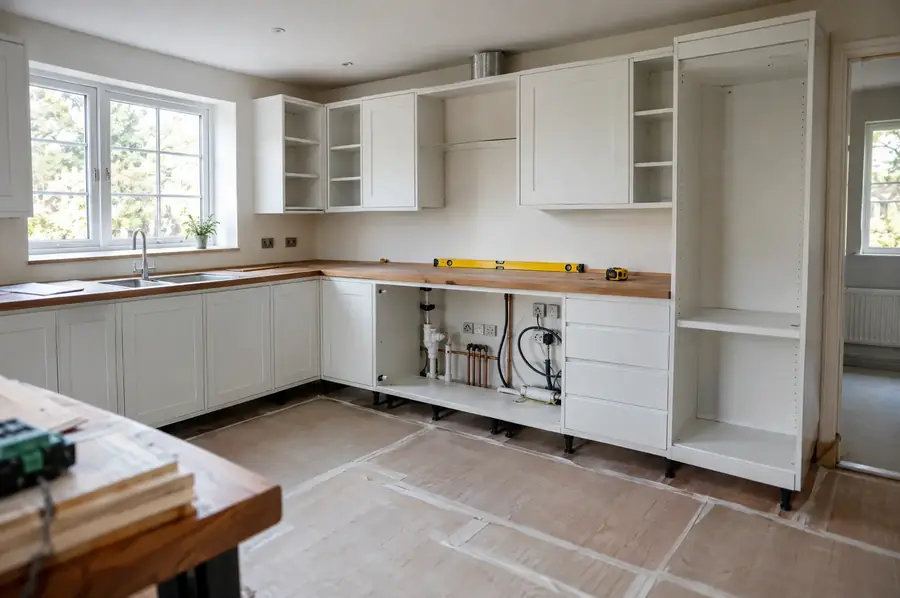
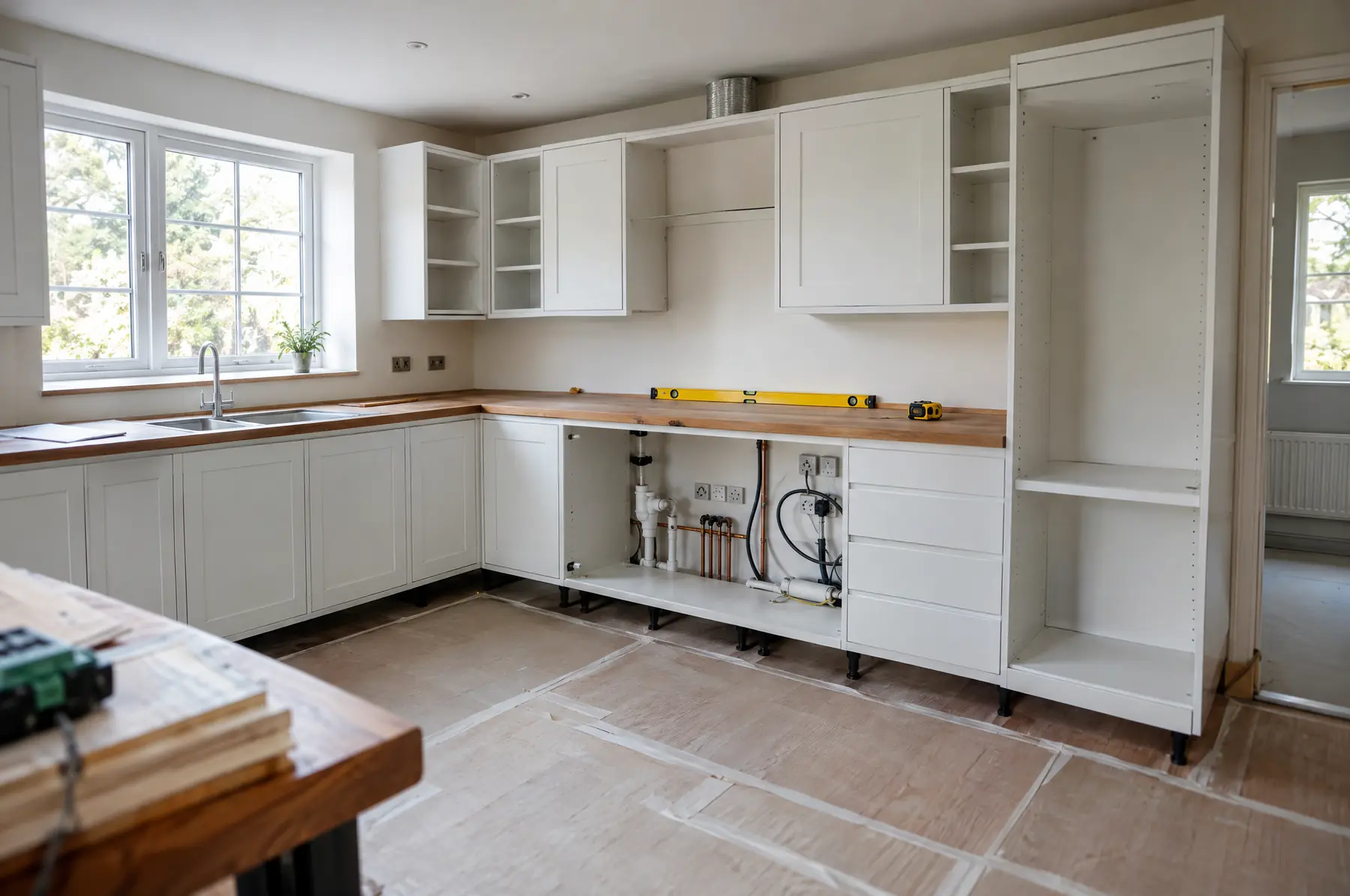
If the kitchen renovation changes the services or the layout, the procedure in the Canary Islands is prior notification to the council, provided the building is not listed and the work does not increase the volume or the buildable area (article 332.1.a). This is the most common case in a kitchen renovation: renewing the plumbing and electrics, moving the sink or the hob, or knocking down a partition wall to open the kitchen to the living room.
Prior notification is submitted at least fifteen days before starting the work (article 350.1). Once submitted with the required documentation, it entitles you to carry out the work without waiting for a decision, although the council can check and inspect it afterwards (article 349.1). The form states who is promoting the work, a written and graphic description of the work, the planned start and end dates and how the rubble will be removed (article 349.3). Each council sets out the supporting documentation and fees in its bylaw (ordenanza); in Santa Cruz de Tenerife and La Laguna these procedures are handled by the municipal planning department (Gerencia de Urbanismo).
Knocking down a partition or touching a load-bearing wall
Knocking down a wall that is not load-bearing is renovation work and goes through prior notification. If the wall is load-bearing, in a building that is not listed the law still places it under prior notification, but the work has to be assessed by a qualified professional (architect or building engineer, depending on the case). When the intervention substantially alters the building’s structural system, the Ley 38/1999 de Ordenación de la Edificación (Building Act 38/1999) requires a project (article 2.2.b), which is attached to the prior notification (article 349.4.a of Ley 4/2017). In older flats in Santa Cruz and La Laguna it is not always obvious at a glance which wall is load-bearing, so check before getting a quote for an open-plan kitchen.
Electrical and gas installations
Work on the electrical installation is carried out by an installation company, which issues the installation certificate on completion (Reglamento electrotécnico para baja tensión, the Low Voltage Electrotechnical Regulation, Real Decreto 842/2002, article 18). For gas, the technical regulation on gaseous fuels reserves the installations specified in its technical instructions for authorised gas installation companies (Real Decreto 919/2006, article 8). These certificates are a separate obligation and do not replace the council procedure.
When a licence is needed
In a kitchen renovation, the planning licence (licencia urbanística) only comes into play in a few of the cases listed in article 330.1: if the work extends the home, if it alters the façade as a whole or glazes terraces in a way that affects the whole façade, or if the building is protected or listed under historic heritage legislation. A licence is also needed to legalise work that was carried out without the permit it required.
Exterior work on buildings that are not listed and that does not change the façade as a whole, such as replacing a window, goes through prior notification (article 332.1.b). If the home is in a historic ensemble, such as the old town of La Laguna, check beforehand whether the building is listed. In that case even interior work may need a licence, and the exemption for finishes does not apply to protected homes.
The owners’ association
To renovate the kitchen inside your home you do not need the owners’ association’s authorisation, but you do need to give notice beforehand. The Ley 49/1960 de Propiedad Horizontal (Horizontal Property Act 49/1960) allows an owner to modify the elements, installations and services of their flat when this does not affect the safety of the building, its general structure, its exterior configuration or condition or the rights of another owner, and obliges them to report the work in advance to whoever represents the association (article 7.1). Also respect the working hours and building rules the association has approved, and protect the lift and common areas.
Outside your home, the same law prevents you from making alterations on your own to the rest of the building. If the work affects the façade, the structure, shared downpipes or ducts or the roof, you need the agreement of the owners’ meeting, with the majority that applies to the type of work. Get it in writing before submitting the council procedure: the council’s permit and the association’s are independent and one does not replace the other.
The extraction outlet
If you connect the cooker hood to a duct that already exists and serves your home, there is no extra procedure beyond whatever applies to the rest of the work. Opening a new outlet through the façade, a light well or the roof is different: you are acting on common elements, so you need the association’s agreement, and as exterior work it is notified to the council (article 332.1.b), unless the building is listed, in which case it requires a licence.
Before counting on that outlet, also check whether your municipality’s planning or bylaws regulate extraction outlets through the façade. If it is not feasible, the alternative is a recirculating hood; the guide to cooker hoods explains when it works and its limitations.
How to organise the procedure
The practical order is to define the work, check which procedure applies to it and submit it with time to spare before setting the installation date. That way you avoid having the units manufactured and the kitchen at a standstill waiting for paperwork.
- Define with the company exactly what will be done: units, finishes, services, partition walls or façade.
- Check on your council’s online portal (sede electrónica) or at its planning office which form and documentation they require.
- If common elements are involved, get the association’s agreement first; if not, still notify the work to whoever represents it.
- Submit the prior notification at least fifteen days before starting, or the licence application if your case needs one, and keep the receipt.
- When finished, notify the council that the work is complete, as the law requires (article 350.4).
All of this fits into the overall planning of the project; the guide on where to start when buying a kitchen in Tenerife sets out the full order of decisions.