Heat and sun, no problem
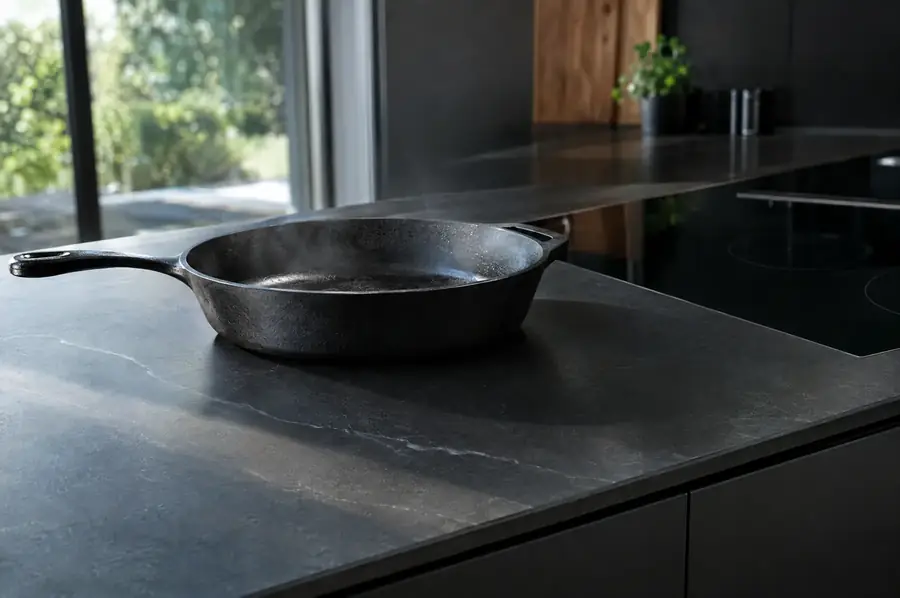
It contains no resins: it takes hot pans and does not change colour in the sun.
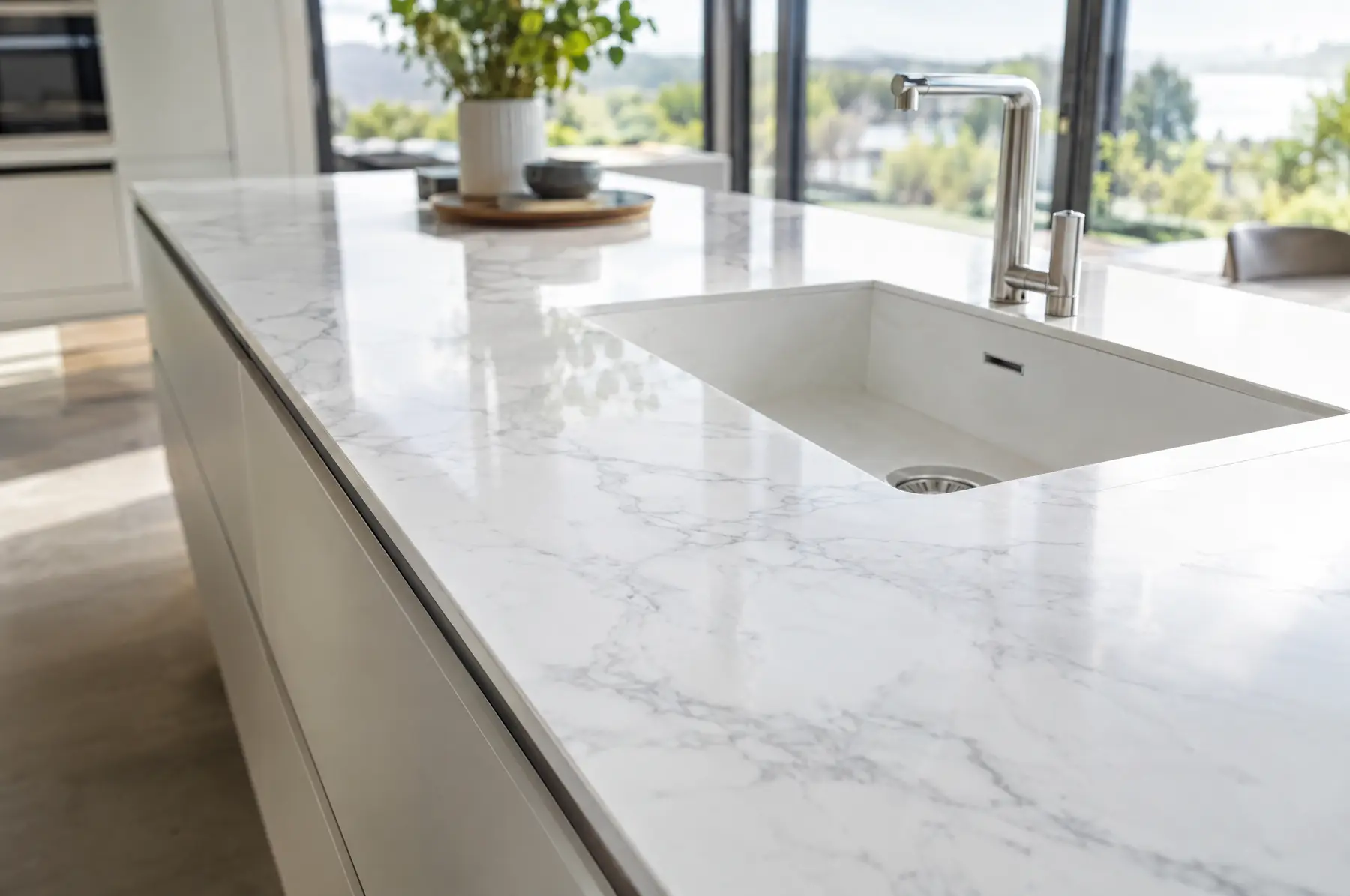
A porcelain worktop is a large-format ceramic slab, slim and virtually non-porous, that copes with heat, sun and stains better than quartz. Its weak point is the edges, which can chip with a sharp knock, so the edge profile needs choosing with care.
It contains no resins: it takes hot pans and does not change colour in the sun.
The large format allows long worktops, splashbacks and island sides with the same pattern.
From sheets just a few millimetres thick for cladding up to 12 or 20 mm for worktops, depending on the manufacturer.
It needs no sealing and cleans with water and mild soap.
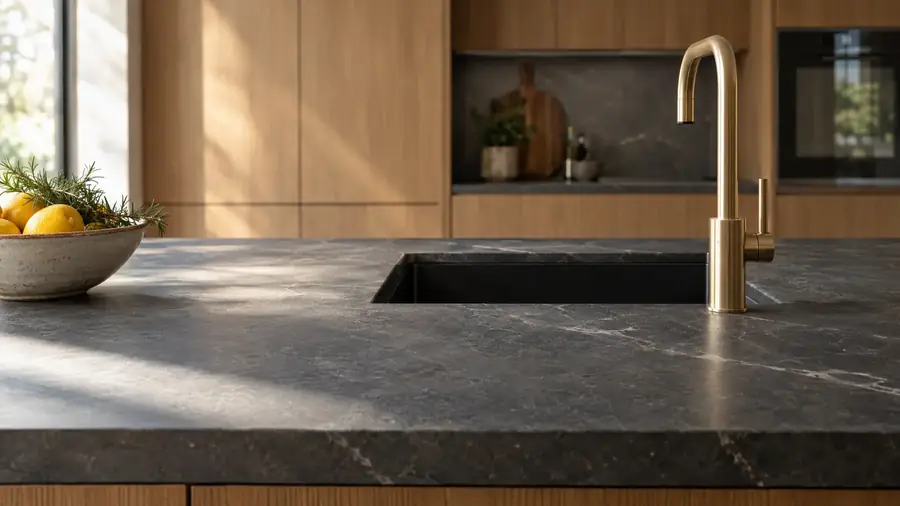
Porcelain worktops have found a place in Tenerife kitchens for two reasons: they take the southern sun without fading and they allow very large pieces with very little thickness. Porcelain is a technical ceramic made from clays, feldspars and other minerals, pressed and fired at very high temperatures, which gives it almost zero water absorption. It is one of the most versatile worktop materials we work with.
The best known for worktops are Neolith, which its manufacturer presents as sintered stone, and Laminam, although several ceramic manufacturers produce large-format slabs for kitchens. Each has its own colour range, thicknesses and cutting and fitting instructions, so the exact performance depends on the model. The most common designs are marble effect, stone effect and concrete effect, in a polished or matt finish.
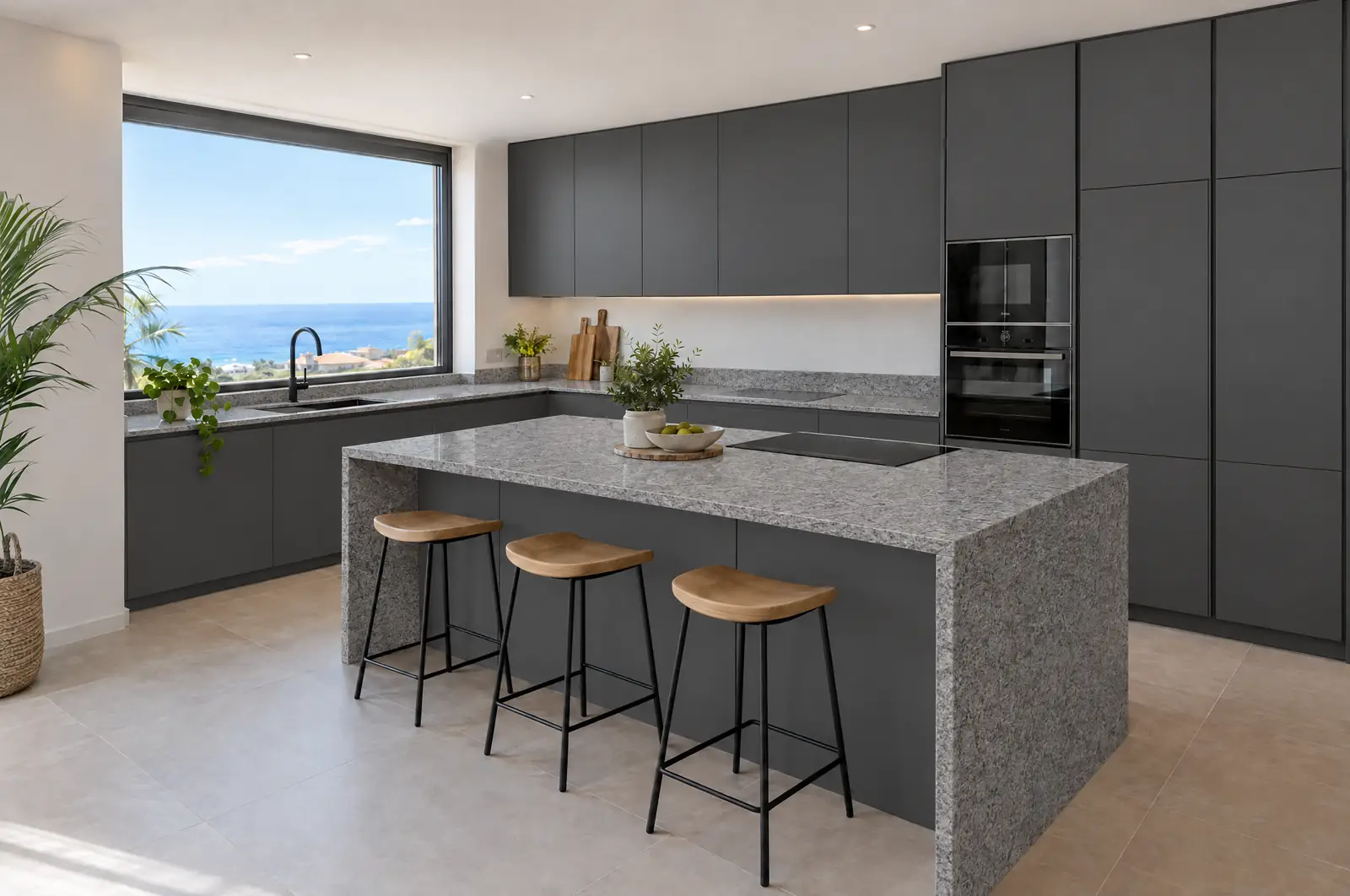
Porcelain for worktops is made in large slabs, over 3 metres long in many models, which cuts down on joints in long worktops. That size makes it possible to clad the worktop, the splashback and the sides of an island as a waterfall in the same pattern, with continuous veining. Thin sheets are used for the splashback, as they are lighter and easier to fix to the wall.
Porcelain worktops usually come in 12 mm, and some manufacturers offer 20 mm. With so little thickness, the edge is the most exposed area: a sharp knock from a cast iron pan or a bottle can chip it. We minimise this in two ways:
There is another important detail: in many models the veining is only on the surface and the body of the slab is a different shade, so a square edge shows that difference. Some ranges have full-body colour or veining. It is worth knowing this before you choose the edge.
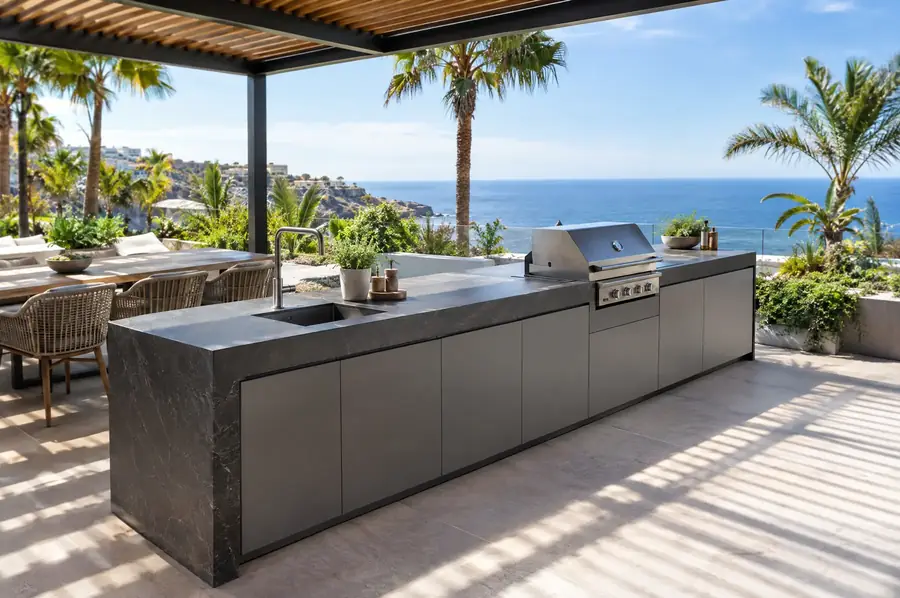
Porcelain is suitable for outdoor use: it contains no resins, so the sun does not yellow it, and its near-zero porosity stops salt air and moisture getting in. That is why it is one of the options we suggest for outdoor kitchens and for seafront homes. On the coast, the thing to watch is usually not the worktop but the hardware and the tap, which are best chosen in marine-grade stainless steel.
It takes an undermount sink, with the edge of the cut-out polished, as well as drainer grooves. Cutting it needs the right machinery and experience with this material, because careless handling can crack the slab. Day to day it only needs water and mild soap; textured matt finishes hold on to dirt a little more than polished ones.
Compared with Silestone quartz it performs better against heat and sun; compared with Dekton the performance is very similar and the choice usually comes down to design and availability. If you are deciding between several, our guide to choosing a worktop compares them in detail. It is normally priced per linear metre, and the price depends on the model, thickness, edges, cut-outs and splashback.
Open the planner with this starting point already chosen. Then change the measurements, units and finishes, and see the drawing and an estimated price including IGIC straight away.
They are very close: both start from minerals pressed and fired at very high temperatures, and in practice they behave in a similar way. The difference lies more in what each manufacturer calls it and in each brand's exact composition than in any radical change in performance.
Yes, the cut-out can be rebated so the hob sits flush, but with slim thicknesses you need to check with the material and hob manufacturers that the rebate does not weaken the slab. At 12 mm it is usual to leave the hob sitting on the surface, which is the safest solution.
A small chip can be filled with resin matched to the surface colour and is well disguised, although you can see it up close. If the veining is only on the surface, the repair is harder to hide, because the filler has to match the colour of the body of the slab, not the face.
See how it would look and what it would cost in the kitchen planner, or ask us to visit and measure your home.
We will reply with a proposed visit and a first price range. If you prefer to talk, message us on WhatsApp.
Your privacy
We use technical cookies so the website works and, only if you accept them, Google Analytics cookies to understand how it is used and improve it. We do not use advertising cookies. Cookie policy