Spotting a quality kitchen does not require being a joiner, but it does require knowing where to look. Two kitchens with the same doors and the same worktop can have very different lifespans depending on the carcass board, the edging and the hardware, which are precisely the parts that appear least in photos and in vague quotes.
The carcass: moisture-resistant board and thickness
The carcass is the box of each unit, and in a quality kitchen it is made of moisture-resistant chipboard of a good thickness. Moisture-resistant chipboard contains resins that make it resistant to damp; in the European board standard it corresponds to the class intended for humid conditions (P3). It is often recognisable by the greenish tone of the cut edge, although the colour is not a guarantee in itself.
The most common thickness in good ranges is 19 mm for the sides, base and top of the unit. Budget kitchens drop to 16 mm, which works, but holds hinge and runner screws less well over time. Look at the back panel too: a 3 mm back that is simply nailed on warps and lets damp through, while a thicker back set into a groove gives the unit rigidity and better supports the weight of wall units.
In Tenerife this matters more than inland on mainland Spain. The sink base unit suffers leaks, condensation and splashes, and in homes near the coast the humidity is high for much of the year. A carcass that is not moisture-resistant swells at the base and cannot be repaired.
Edging: where damp gets in
The edging is the strip that covers the edge of the board, and it is the first place water gets in. A thin 0.4 mm edge stuck with conventional glue comes away with damp and the heat from the dishwasher; an edge 1 to 2 mm thick, properly rounded, protects much better.
The bonding technique matters too. Edging applied with polyurethane glue or by laser leaves an almost invisible joint and withstands water and heat much better than edging stuck with conventional glue. Run your finger along the edge of a door and along the bottom edge of a side panel: if you can feel the glue line or the edging lifts at a corner, that is a bad sign.
Soft-close hinges with adjustment
The hinges in a quality kitchen have the soft-close mechanism built into the hinge itself and adjust in three directions. Those with the damper as an add-on part depend on one more component that can work loose or come off with use.
Adjustment in height, depth and side to side lets the gaps between doors be lined up perfectly after fitting and readjusted over the years. The number of hinges per door is not optional: hardware manufacturers set it according to the height and weight of the door, and a tall unit door usually needs three or four. If a tall door has only two, ask why. In coastal areas, ask whether the hardware has an anti-corrosion treatment, because salty air attacks metal before wood.
Drawer runners: full extension and load
Drawers are the most used part of a kitchen, and in a good kitchen they have concealed full-extension runners with soft-close. Full extension means the drawer comes all the way out and you can reach the back without bending down to search; partial-extension runners leave a quarter of the drawer inside the unit.
Pay attention to the load they can bear. A full pan drawer weighs a good deal more than it looks, and a weak runner eventually gives way and rubs. Open a drawer in the showroom, push it shut firmly and check that it slows down without bouncing back and has no side-to-side play when pulled out. Double-walled metal drawer sides are sturdier than board sides on roller runners.
Doors: material and finish
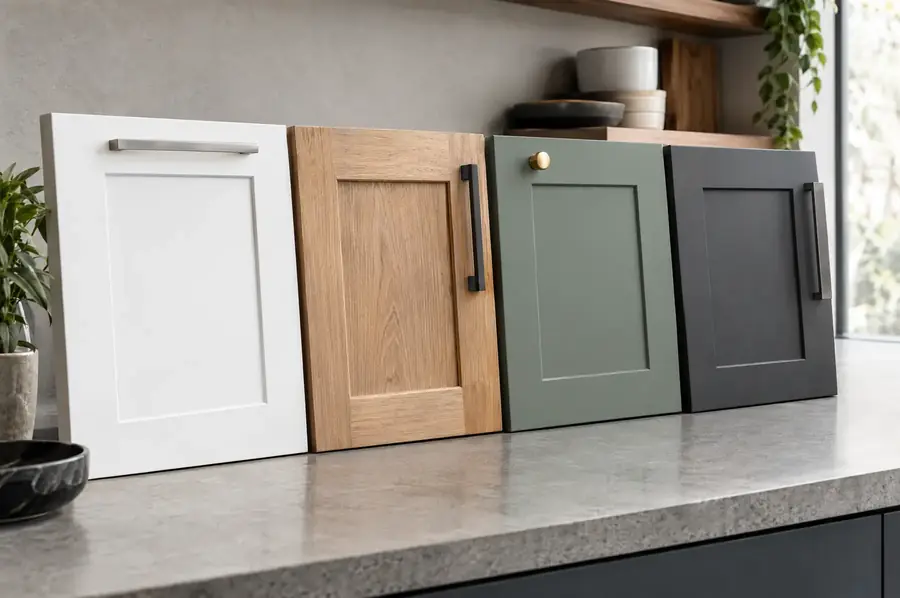
The door is what you see, but its quality depends on the core and the finish as well as the colour. The most common are laminate, high-pressure laminate, lacquer and natural wood veneer, and each behaves differently.
- Laminate: affordable and hard-wearing, with a good range of wood effects. Its edges are the weak point.
- High-pressure laminate: thicker and harder than standard laminate, it copes better with knocks and heat.
- Lacquer: allows any colour and a seamless finish, but is more sensitive to knocks and, in light shades, can yellow if it gets direct sun.
- Wood veneer: a genuinely natural look; it needs a good varnish and darkens or lightens with light over the years.
Check that the doors are finished with the same care on the inside as on the outside and that the edges are equally well finished on all four sides.
The plinth and the legs
The plinth protects the base of the units and, in a well-designed kitchen, it is aluminium or another water-resistant material, with a seal along the bottom against the floor. An unprotected board plinth soaks up water from the mop and swells within a few years.
Behind the plinth, the base units stand on adjustable legs. Sturdy legs with a wide adjustment range allow the kitchen to be levelled on uneven floors, which are common in older houses in the north of the island. The plinth should be removable so you can reach the service points or retrieve something that has fallen underneath.
How to recognise good fitting
Good fitting shows in units that are level and fixed to the wall, gaps between doors that are the same throughout the kitchen, and finishing pieces against the wall and ceiling that fit tightly without gaps. It matters as much as the materials: a kitchen made of good materials but badly fitted works worse than a simple one that is well installed.
Also check what stays hidden: the seal between worktop and wall, the sink seal, the protection of the carcass under the dishwasher and pipes passing through without improvised cuts in the back panels. In a made-to-measure kitchen these details are solved in the workshop; in a modular kitchen they are adjusted on site with filler panels and trimming, and every adjustment made in the property is one more point worth checking.
How to compare quotes with this list
The most practical way to compare is to ask for each quote to state the points in this table in writing. If an offer does not detail them, ask: these are facts that whoever makes or sells the kitchen knows.
| Element | What the quote should state | Warning sign |
|---|---|---|
| Carcass | Moisture-resistant board (P3) and thickness | Just “chipboard”, or 16 mm with no mention of moisture |
| Back panel | Thickness and whether it is set into a groove | Thin back panel nailed on |
| Edging | Thickness and bonding method | 0.4 mm edging or not specified |
| Hinges | Built-in soft-close and three-way adjustment | “Soft-close hinge” with no further detail |
| Drawer runners | Full extension, soft-close and load capacity | Partial extension or roller runners |
| Doors | Material and finish (laminate, high-pressure laminate, lacquer, veneer) | Only the trade name of the colour |
| Plinth | Material and seal against the floor | Unprotected board plinth |
| Fitting | Who measures, removal, disposal, connections and adjustments | Fitting as a single lump sum with no breakdown |
If the budget is tight, prioritise a moisture-resistant carcass and good hardware over expensive doors, because the doors can be replaced later and the carcass cannot. That is also the logic behind a well-planned affordable kitchen: save on finishes, not on the structure. And if you are torn between worktop materials, the comparison of Silestone, Dekton, granite and porcelain will help you decide.